
Yorkie Biting: Why Your Yorkie Bites and How to Stop It
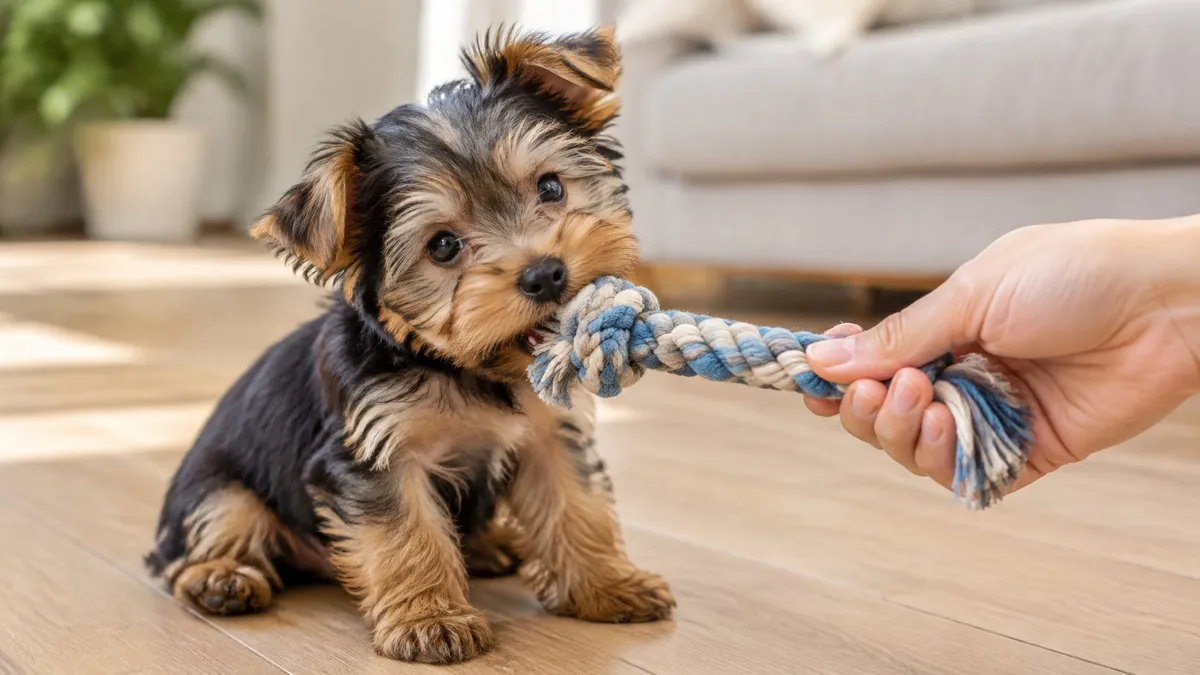
Most Yorkie biting is a puppy learning to use its mouth gently. Some of it is a dog saying “I’m scared” or “that hurts.” Here is how to tell which one you have, and what to do about each.
Quick Answer
Yorkie puppies bite because mouthing is normal puppy play, and Yorkies keep teething until about 6 months. Redirect the biting to a toy, and stop the game for 10 to 20 seconds whenever teeth touch skin. An adult Yorkie who bites when touched, picked up or near its food needs a different plan, and a Yorkie who suddenly starts biting should see a vet first, because pain is a common cause.
Why is my Yorkie biting? Find out in a minute
Biting has different causes, and each needs its own fix. Answer five questions to see the most likely reason and a plan for your dog.
Yorkie puppy biting: what’s normal
Puppies explore with their mouths and play by biting each other. That play is how they learn bite inhibition: when one puppy bites too hard, the other yelps and stops playing, and the biter learns to be gentler. Your puppy needs to learn the same lesson with people, whose skin is much more sensitive than a littermate’s fur.
Teething adds to it. Yorkies lose their baby teeth later than many puppy charts suggest. In a study that followed 61 Yorkie puppies, a typical 10 lb Yorkie lost its baby incisors at about 22 weeks and its baby canines at about 26 weeks, and very small Yorkies lost them later still. Expect a mouthy puppy until around 6 months.
Yorkies are also prone to retained baby teeth, where a baby tooth stays in after the adult tooth comes through. Ask your vet to check at around 6 to 7 months, and see our Yorkie dental care guide.
How to stop a Yorkie puppy from biting
- Always have a toy between you. Play with a soft toy or tug rope, never bare hands, so your puppy always has something it is allowed to bite.
- Make biting end the fun. When teeth touch skin, say “ouch” in a high voice, go still, and stop playing. If your puppy keeps at it, stand up and walk away for 10 to 20 seconds, then start again calmly.
- Don’t pull away fast. Snatching hands and feet away looks like a game of chase. Freeze instead.
- Watch for overtired biting. Puppies get bitey when they need sleep. If the biting ramps up, a nap in a quiet crate or pen often fixes it.
- Give teething something to chew. Rotate a few safe chews and toys. See our picks of chew toys for Yorkie puppies.
- Reward the gentle moments. Praise and treat when your puppy licks or sniffs your hand instead of biting it.
If yelping makes your puppy more excited instead of less, skip the “ouch” and simply stop playing. More ideas: chew toys for Yorkie puppies and the best training treats for Yorkies.
Ankle and feet biting
Moving feet are irresistible to a puppy. Stop walking the moment it grabs your ankle, wait until it lets go, then toss a toy away from your feet. Keep a toy in your pocket for the times of day it happens most.
Why adult Yorkies bite
An adult who still mouths during play probably never learned to be gentle as a puppy. That is fixable with the same steps as above, though it takes longer. Biting that comes with growling, a stiff body or a fast, hard snap is different. It usually comes from one of these:
Pain
The most common hidden cause in a dog who used to be gentle. Dental disease is the most common problem vets diagnose in Yorkies, and slipping kneecaps (patellar luxation) are also common in the breed.
Fear
Being picked up suddenly, reached for, or cornered by visitors or bigger dogs. Small dogs get handled a lot, so they have more chances to feel trapped.
Handling and grooming
Brushing out mats, nail trims and baths can hurt or scare a dog, and the biting can carry over to any touch.
Resource guarding
Snapping when someone comes near food, chews, toys or a favorite spot.
If your Yorkie starts biting out of the blue, see your vet before you start training. Pain often shows up as snapping when the sore spot is touched. In a large UK study of Yorkies under vet care, males were more likely than females to be recorded with aggression, and dental disease was the most common problem in the breed.
For the bigger picture on temperament, read are Yorkies aggressive? If the problem is barking at the same triggers, our guide to Yorkie barking problems uses the same calm, gradual approach.
The warning signs before a bite
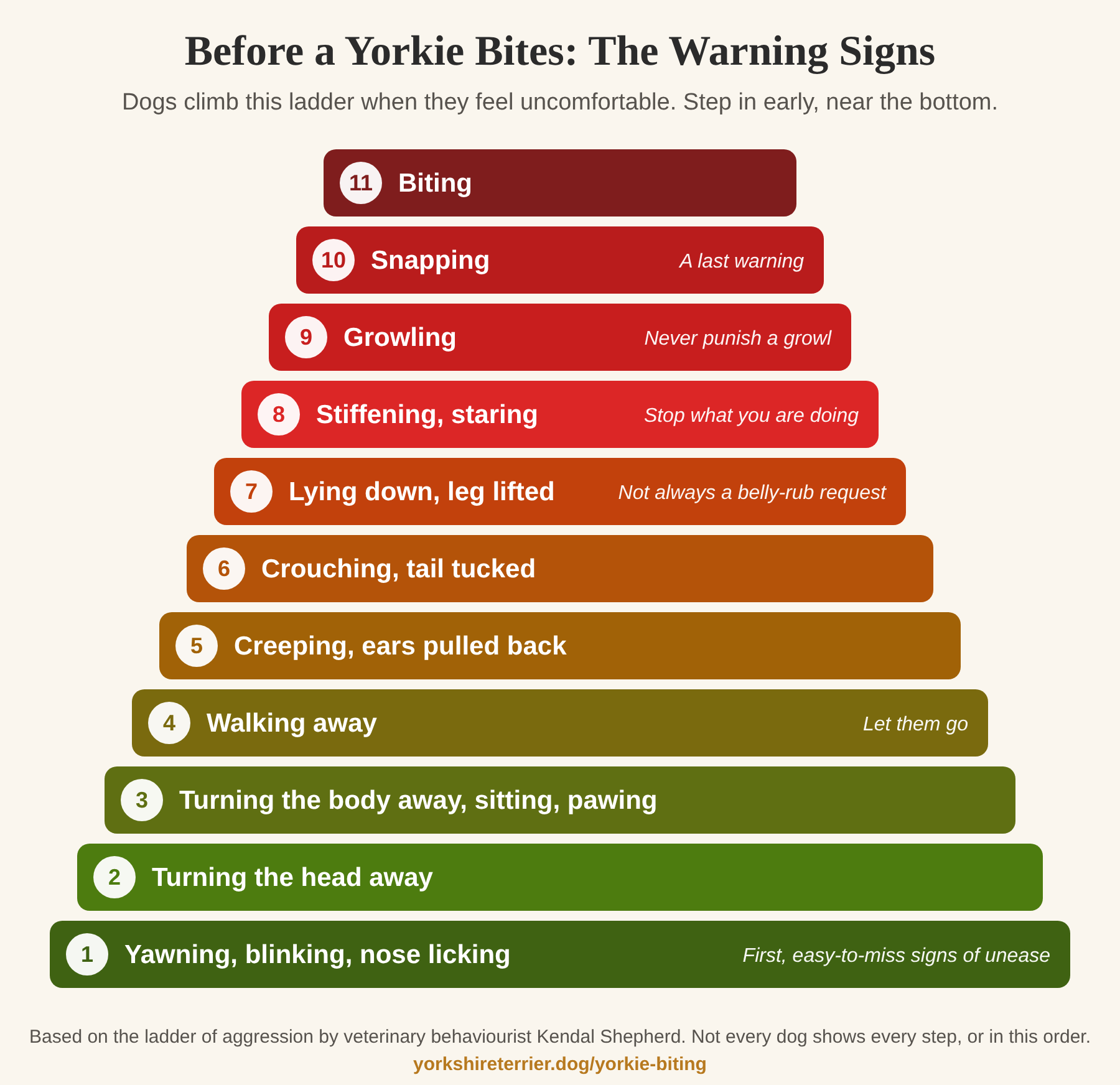
Dogs rarely bite without warning. They climb a ladder of signals, starting with small ones that are easy to miss: a lick of the lips, a yawn, turning away. If those are ignored, the signals get louder: stiffening, a growl, a snap. Learn the lower steps and you can stop whatever is bothering your Yorkie long before it bites.
Swipe sideways to see the whole chart, or download it below.
Never punish a growl. A dog who is told off for growling learns to skip the warning, not to feel better, and the next bite can come with no notice.
Share this chart
Free to use on your site, in a class or on your fridge. Download the image, or copy this code to embed it with a credit link:
What not to do
- Hitting, flicking the nose, or holding the mouth shut. It teaches your dog that hands are scary.
- Pinning your dog down or “alpha rolling.” It raises fear, and fear causes most biting.
- Punishing growls. See above: it removes the warning, not the problem.
- Rough play with hands, or teasing to make your puppy bite.
- Grabbing food or toys out of your dog’s mouth. Trade for a treat instead.
When to get help
- A bite has broken skin, or your dog has bitten a child.
- The biting is getting worse, or happens with no warning signs you can see.
- Your Yorkie guards food or toys from people.
- A gentle adult or senior dog has suddenly started biting: see the vet first.
Start with your vet to rule out pain, then work with a qualified, reward-based trainer or a veterinary behaviorist. Browse our Yorkie trainer directory to find someone near you.
Questions people ask
At what age do Yorkie puppies stop biting?
There is no switch-off date, but puppy mouthing usually eases once teething is over. Yorkies finish later than many breeds: in a study of 61 Yorkie puppies, the baby canines fell out at around 26 weeks, roughly 6 months, and later in very small Yorkies. If you teach a soft mouth along the way, the biting usually eases once the adult teeth are in. If nobody teaches it, the habit can carry into adulthood.
Why does my Yorkie bite me and no one else?
Usually because you are the one who plays with, handles and grooms them most. Puppies and young dogs mouth the people they play with. If it happens when you pick them up, brush them or reach for a toy, look at handling sensitivity, pain or guarding instead.
Is it normal for a Yorkie puppy to bite a lot?
Yes. Mouthing and play biting are normal puppy behavior, and they are how puppies learn how hard is too hard. The goal is to teach a gentle mouth and give the biting a better target, not to stop your puppy using its mouth at all.
Should I punish my Yorkie for growling?
No. A growl is a warning, and it gives you the chance to stop before a bite. Dogs who are punished for growling can learn to skip the warning and bite with no notice. Find out what made your dog uncomfortable and change that instead.
Why did my older Yorkie suddenly start biting?
A sudden change in an adult or senior dog often points to pain or illness, so see your vet first. In Yorkies, dental disease is the most common problem vets diagnose, and slipping kneecaps and other sore joints can make being picked up painful.
Are Yorkies more likely to bite than other dogs?
Not as a rule. Any dog can bite when scared, hurting or pushed past its warnings. Small dogs are often handled more and picked up without warning, which gives them more reasons to snap. You can read more in our guide to whether Yorkies are aggressive.
Sources
- Wallis C, et al. Development of Yorkshire Terrier dentition. Veterinary Sciences, 2023 (61 Yorkie puppies; tooth-loss ages).
- O’Neill DG, et al. Yorkshire Terriers under primary veterinary care in the UK: demography and disorders. Companion Animal Health and Genetics, 2025.
- ASPCA, Mouthing, nipping and play biting in adult dogs.
- American Kennel Club, Puppy mouthing: expert tips.
- PDSA, Canine communication: the ladder of communication (after Kendal Shepherd, BSAVA Manual of Canine and Feline Behavioural Medicine, 2009).
- Dogs Trust, Mouthing, nipping and puppy biting.
This article is general information, not veterinary or behavioral advice for your individual dog. The warning signs chart and teething chart are original graphics by YorkshireTerrier.dog.